
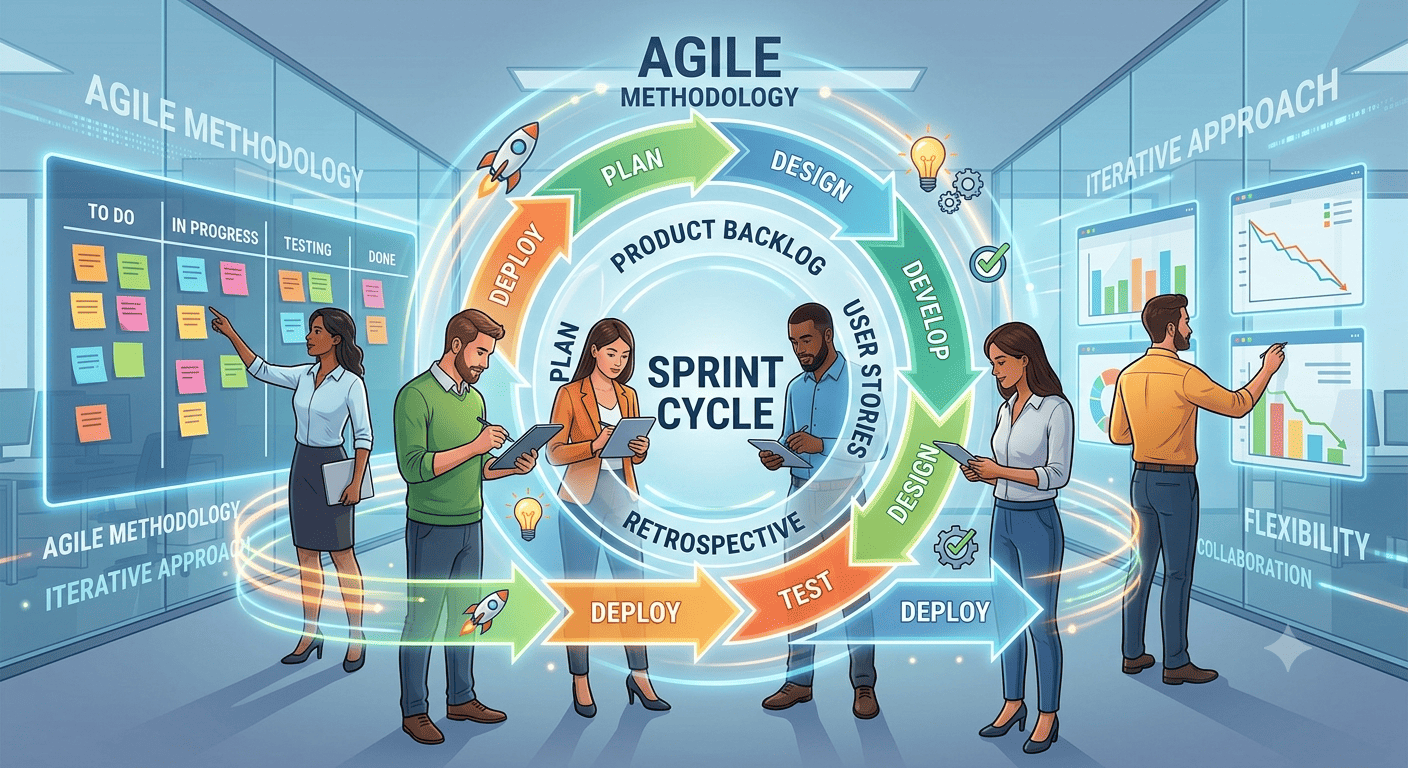
Why Agile methodology in project management?
Every project starts with a choice: plan everything upfront, or plan as you go. That choice shapes how a team works, how it handles surprises, and when the client finally sees results. Here is how the traditional Waterfall approach compares with Agile.
The traditional approach (Waterfall)
Traditional project management relies on a linear and sequential process that follows a set plan or blueprint. Each stage of the project must be completed before moving on to the next, with little room for changes or flexibility. It typically involves a detailed project plan, a fixed timeline, and a strict budget.
The Agile approach
Agile project management is iterative and adaptive. It emphasizes collaboration, flexibility, and constant feedback. Agile teams work in short cycles, called sprints, and prioritize delivering working software or products early and often. Instead of sticking to a fixed plan, they adapt to changes as they arise.
Waterfall follows the plan. Agile follows the feedback.
Key differences
Here is how the two approaches differ in four areas.
-
Planning
Traditional: heavy focus on upfront planning and detailed project plans.
Agile: adaptive planning and continuous iteration.
-
Team structure
Traditional: a strict hierarchy with defined roles.
Agile: self-organizing, cross-functional teams.
-
Delivery
Traditional: a complete project delivered at the end of the timeline.
Agile: working products delivered in smaller increments throughout the project.
-
Change management
Traditional: may struggle to accommodate changes to scope or requirements.
Agile: built for flexibility and adaptability to change.