
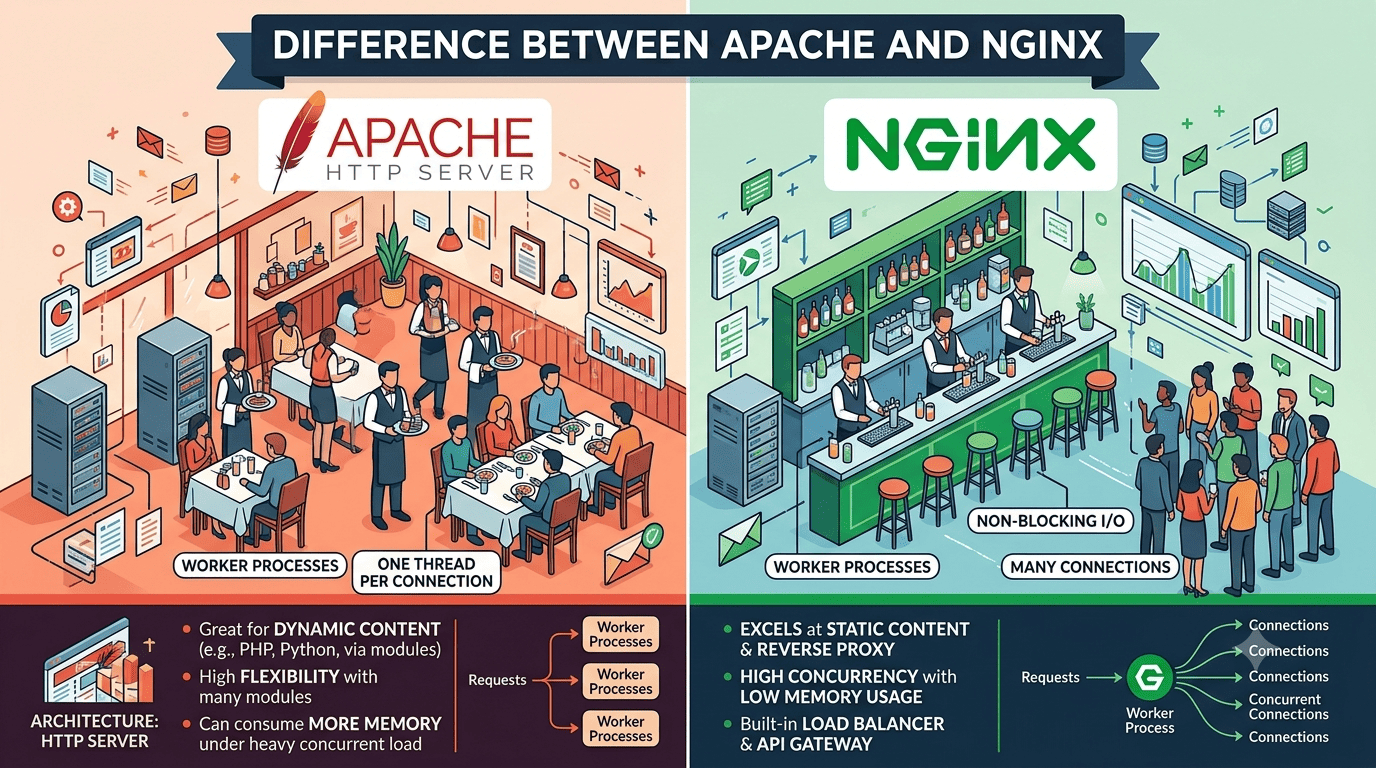
What is the difference between NGINX and Apache?
Nginx and Apache are both popular web servers, widely used to serve static and dynamic web content. Here are the key differences between the two.
Nginx is built for speed and efficiency. Apache is built for flexibility.
Key differences
-
Architecture
Nginx: Designed as a high-performance, low-resource web server that excels at serving static content and reverse proxying to other servers.
Apache: A more traditional web server designed to be highly configurable and flexible, with support for a wide range of modules and extensions.
-
Performance
Nginx: Often faster and more efficient, especially when serving static content. Its event-driven, non-blocking architecture can handle many more connections at the same time.
Apache: Uses a process-based, blocking architecture, which handles fewer simultaneous connections.
-
Configuration
Nginx: Still highly configurable, but uses a simpler, more streamlined configuration syntax.
Apache: Known for powerful, flexible configuration options that allow a high degree of customization and control.
-
Load balancing
Nginx: Has built-in support for load balancing and can distribute incoming requests across multiple servers.
Apache: Requires additional modules to achieve the same functionality.
-
Security
Nginx: Often considered more secure because of its smaller codebase and more minimalist design.
Apache: Also has strong security features.
In summary
Nginx is often preferred for its speed, efficiency, and built-in load balancing, while Apache is favored for its flexibility and powerful configuration options. Ultimately, the choice between the two depends on the specific needs and priorities of your web application.